


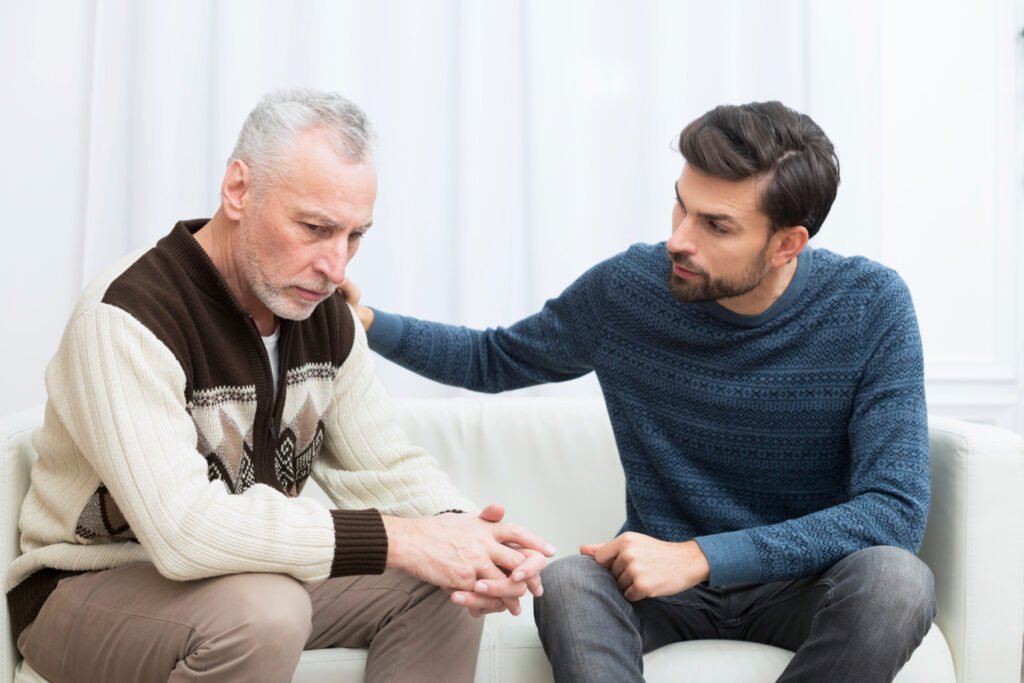

Beyond cognition: Personality changes after a stroke
When people think about stroke recovery, they usually picture physical rehabilitation: relearning to walk, regaining strength in an arm, working on speech. What’s talked about far less is that stroke can also change who someone is — their temperament, their emotional reactions, the personality traits that friends and family have always used to describe them.
This is one of the most disorienting parts of stroke recovery, both for survivors and the people who love them. A person can make excellent physical progress and still come home feeling like a different person to those around them — quieter, more irritable, less motivated, or more anxious than they used to be. These changes are rarely talked about in hospital discharge conversations, which means families are often left trying to make sense of them alone.
This article looks at why personality and emotional changes happen after stroke, what the research tells us, and practical strategies for survivors and the people supporting them.
Table of Contents
Stroke or brain injury: what’s the difference
You’ll often see the terms “stroke” and “brain injury” used interchangeably, and while they’re closely related, they’re not quite the same thing.
Acquired brain injury (ABI)
Is the umbrella term for any damage to the brain that happens after birth (as opposed to a birth injury or a genetic condition). It covers a range of causes, including traumatic injuries such as falls or road traffic collisions, brain tumours, infections such as encephalitis, and periods of oxygen deprivation.
Stroke
Is one specific type of ABI, caused by a disruption to the brain’s blood supply, either because a vessel is blocked (an ischaemic stroke) or because it bleeds (a haemorrhagic stroke). It’s the single most common cause of acquired brain injury in the UK, affecting over 100,000 people each year.
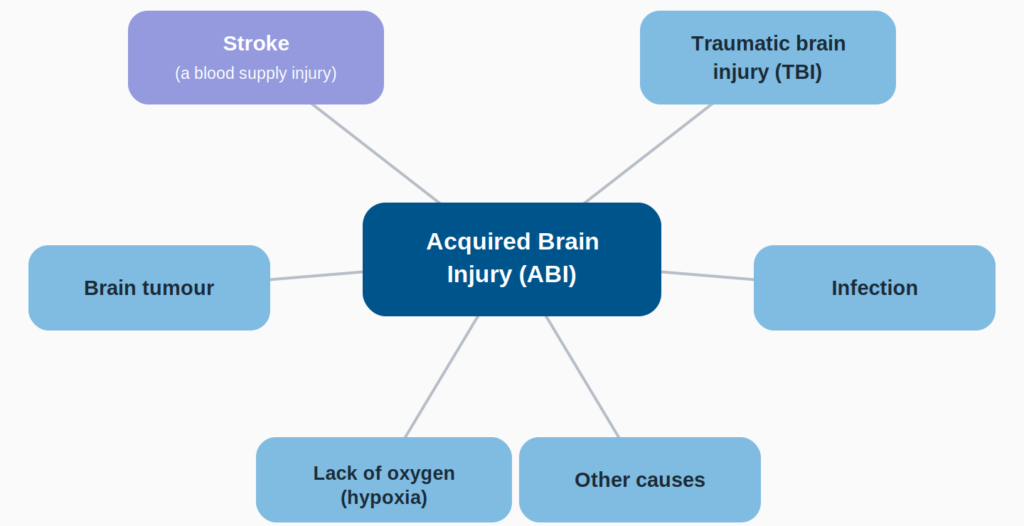
Why does this distinction matter here? Because almost everything we know about personality change after traumatic brain injury also applies to stroke, and vice versa — the underlying mechanism is the same. Damage to certain areas of the brain, particularly the frontal lobes and the networks that connect them to the rest of the brain, can alter mood regulation, impulse control, motivation and self-awareness, regardless of whether the damage was caused by a clot, a bleed, or a blow to the head. So when you read research on personality change after ABI more broadly, it’s directly relevant to stroke survivors too.
Don’t miss a word – get weekly psychology insights straight to your inbox
A piece of advice for you, unpublished anywhere else. Miss a Wednesday, miss the insight.
Emotional changes after a stroke
Emotional changes are extremely common after stroke, and they’re not a sign of weakness or a failure to “bounce back.” The Stroke Association’s own research found that around 90% of stroke survivors experience some level of cognitive difficulty, and roughly 75% experience at least one mental health problem following their stroke. These figures matter because they show emotional change isn’t the exception after stroke; it’s closer to the rule.
Some of the most common emotional changes include:
- Anxiety and worry — often about falling, having another stroke, or being unable to cope
- Low mood, hopelessness and depression — which can develop weeks or months after the event, not just immediately afterwards
- Frustration and anger — often linked to communication difficulties, fatigue, or the loss of independence
- Emotional lability — sudden, hard-to-control shifts in emotion, such as crying or laughing more easily and unpredictably than before. It burdens day-to-day life, that’s why it’s a liability
- Apathy — a flattening of motivation and interest that can look like low mood but has a different underlying cause and needs a different response
There are two overlapping reasons why these changes happen. The first is direct: damage to areas of the brain involved in regulating emotion can change how emotions are generated and controlled, independent of the person’s circumstances. The second is psychological: adjusting to sudden, often permanent, changes in ability, identity, and independence is genuinely difficult, and a grief-like response is a normal part of that adjustment. In most survivors, both mechanisms are at play at once, which is part of why emotional changes after stroke can look so different from person to person.
Personality changes after a stroke
Emotional changes are usually easier for people to name; personality change is subtler and often only becomes clear over time. Family members will describe it in everyday language: “He’s just not himself,” “She’s got no patience anymore,” or “He used to be the life of the party and now he barely wants to leave the house.”
Research into personality change after acquired brain injury gives some shape to what families are noticing. Studies comparing pre- and post-injury personality traits have found consistent patterns, and — importantly — these traits are linked to real rehabilitation outcomes, including how much survivors engage in activities and social participation, and how likely they are to experience depression.
For a plain-language overview of this topic from a patient perspective, the American Stroke Association’s guide to personality changes after stroke is a good starting point.
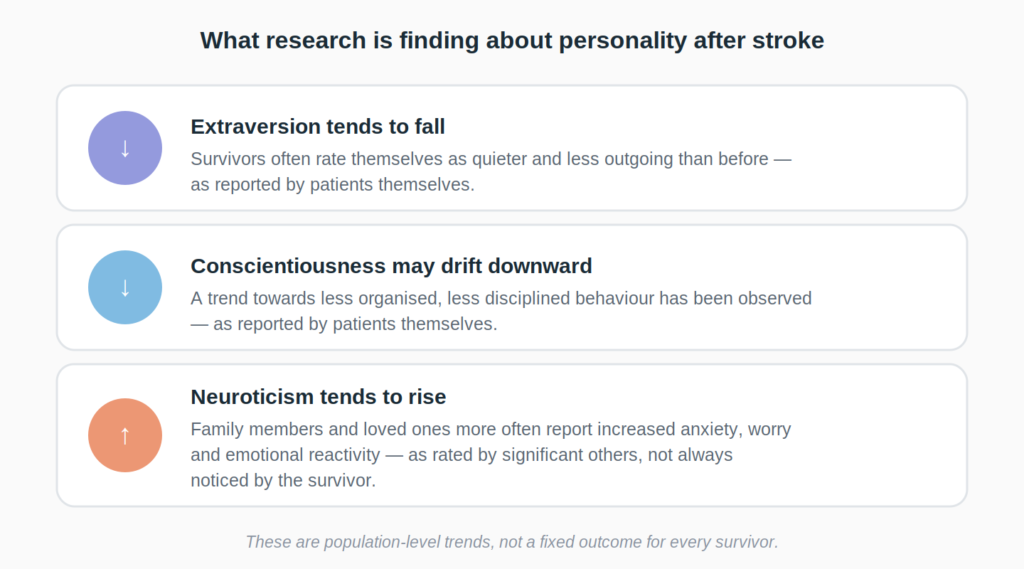
Three patterns show up repeatedly:
- Extraversion tends to decrease. Survivors often rate themselves as less outgoing, less sociable, and less inclined to seek out company than they were before their stroke.
- Conscientiousness shows a downward trend. This trait relates to organisation, reliability and self-discipline, and some survivors notice they’ve become less consistent in these areas.
- Neuroticism tends to increase — but this is mostly picked up by others. Family members and loved ones are considerably more likely than survivors themselves to report increased anxiety, worry and emotional reactivity. This gap between self-report and family report is one of the most clinically important findings in this area: survivors don’t always recognise the change in themselves, which is part of why it can be so distressing for the people around them.
This last point is worth sitting with. It’s not unusual for a survivor to feel they’re managing well, while a partner or adult child feels like they’re living with someone different. Neither perspective is “wrong” — reduced self-awareness after brain injury is itself a well-documented consequence, not a character flaw or denial. Recognising that this gap exists, and that it’s a known feature of recovery rather than a sign that something has gone wrong, can take a lot of pressure off both sides.
Strategies for the family and people supporting the individual
Supporting someone through personality and emotional change is exhausting, and it’s easy to feel like nothing you do is quite right. These strategies, drawn from clinical practice in cognitive rehabilitation, tend to help:
- Keep the environment calm and free of distractions when you need to have an important conversation, and make sure you have the person’s attention before you start speaking.
- Slow down and simplify. Use short sentences, one idea at a time, and avoid asking more than one question in a row. Pause naturally at the end of phrases rather than rushing on.
- Give them time to respond. Resist the urge to finish sentences or jump in with the answer — it can feel patronising, even when it’s meant kindly.
- Watch for signs of overwhelm, such as a vacant expression, a lack of response, or visible distraction, and be ready to pause or step back when you notice them.
- Support understanding both ways. If you’ve understood part of what they’ve said, repeat it back so they don’t have to repeat the whole thing, and gently ask them to summarise what they’ve understood from you.
- Don’t stretch conversations beyond what’s comfortable. A shorter, calmer conversation is more useful than a longer one that ends in frustration for both of you.
- Keep the door open to social contact. It can be tempting to protect someone by reducing the demands on them, but maintaining some level of social engagement, at a pace that suits them, supports both mood and long-term recovery.
- Separate the person from the behaviour. Frustration, flat affect or a short temper are very often symptoms of the injury rather than a change in how someone feels about you. That distinction doesn’t make the day-to-day easier, but it does matter for how you interpret what’s happening. Stop saying “You are now…” and begin saying “X behaviour more recently makes me feel Y”.
Tips for the stroke survivors
If you’re the one recovering, some of what’s happening to your mood, motivation and patience can feel confusing or even frightening. A few strategies that survivors often find helpful:
- Keep a daily diary. Note down what you did each day and what went well, even small things. This supports both mood and memory, and gives you (and your clinical team) a clearer picture of patterns over time.
- Build in activities that give you a sense of pleasure or achievement, even in small doses. Motivation often follows action rather than the other way round — waiting to “feel like it” can mean waiting a long time.
- Pace yourself. Take breaks before you feel exhausted, rather than pushing through until you crash. Post-stroke fatigue is real and physiological, not a lack of effort, and balancing demanding tasks with lower-energy ones helps prevent the boom-and-bust cycle.
- Protect a regular routine. Structure and predictability reduce the cognitive load of each day and can help stabilise mood.
- Give yourself permission to slow down and check your work, whether that’s a task, a conversation, or a decision. Taking a moment before responding supports better self-monitoring and can reduce frustration for everyone involved.
- Stay connected to others, even when it feels easier to withdraw. Reduced extraversion after stroke is common, but isolation tends to make mood and motivation worse over time, not better.
- Use physiotherapy and exercise recommendations as part of your mood plan, not just your physical one.Movement has a genuine, evidenced effect on mood after brain injury.
When to seek treatment and further support
Emotional and personality change after stroke is common, but that doesn’t mean it should go unaddressed. It’s worth seeking specialist support if:
- Low mood, anxiety or apathy is lasting for weeks and isn’t easing
- Frustration or emotional outbursts are affecting relationships, work, or day-to-day safety
- You (or your family) are noticing personality changes that feel significant, even if you’re managing physically well
- Family members feel like they don’t know how to communicate with, or relate to, their loved one anymore
- Motivation to engage in rehabilitation, social activities or previously enjoyed hobbies has dropped off significantly
The right support usually comes from clinicians with specific expertise in neuropsychology, not generic talking therapy alone. This matters because emotional and personality changes after stroke often have a neurological basis as well as a psychological one, and effective treatment needs to address both. A stroke specialist neuropsychologist can properly assess what’s driving the changes you’re seeing, distinguish between (for example) depression and apathy, or between anxiety and cognitive overload, and build a rehabilitation and treatment plan around the individual, not a generic checklist.
The evidence for this kind of specialist input is strong: comprehensive reviews of neuropsychological rehabilitation have documented improved quality of life, better return to independence, and genuine cost savings in social care, alongside better outcomes for returning to work and daily life. Getting the right support in place isn’t an indulgence — it’s one of the most effective things you can do to protect both recovery and quality of life, for the survivor and the people around them.
If you or a family member are noticing personality or emotional changes after a stroke, our neuropsychology team can help assess what’s happening and put the right support in place. Get in touch to find out more.
